


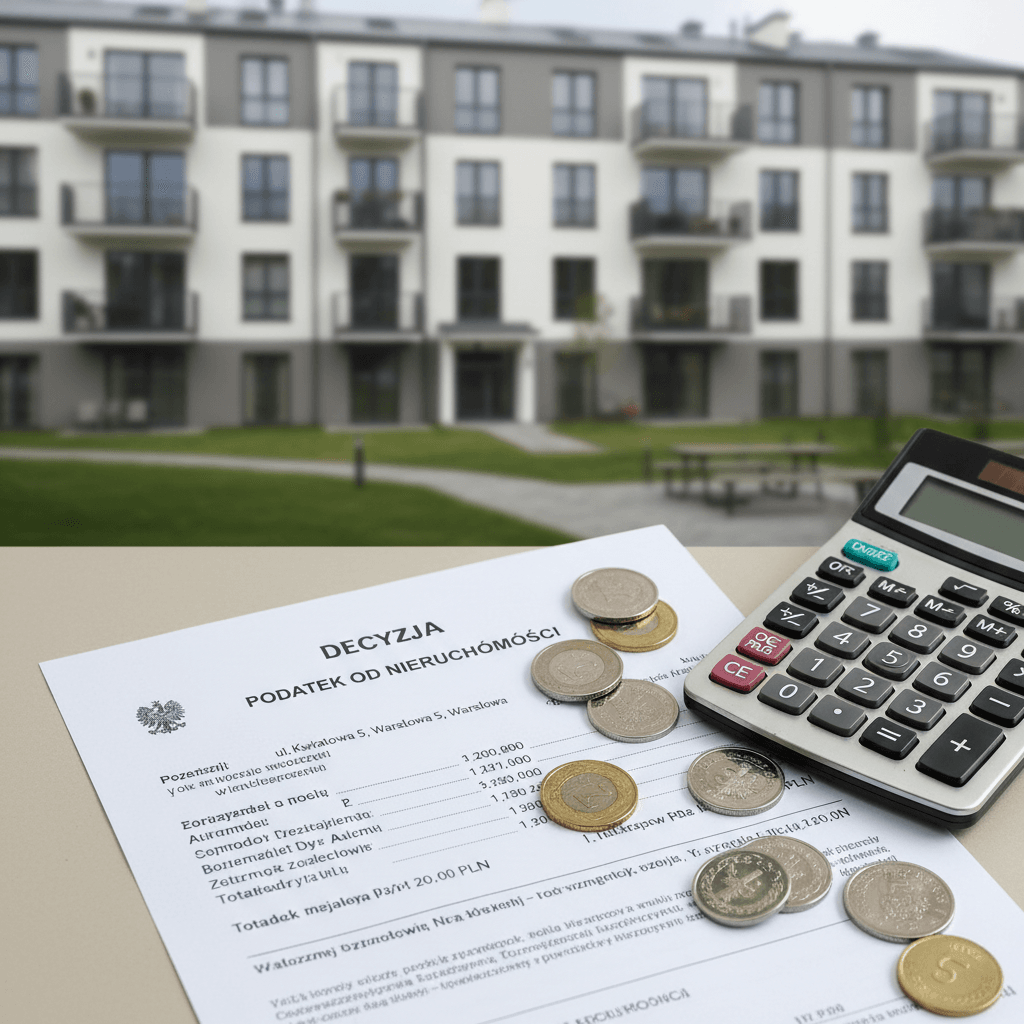
Annual property tax in Poland — known as podatek od nieruchomości — is a local tax paid every year by the owner of real estate: land, buildings, and structures. As a foreign buyer who acquires a flat or house in Poland, you become liable for this tax from the day you take ownership. Understanding the rates, how to calculate your bill, and when and how to pay is essential for budgeting your total cost of ownership.
This guide covers the Polish property tax system in full: who pays, how rates are set, what the 2024–2026 maximum rates are, and what exemptions exist.
📚 REAL ESTATE IN POLAND — COMPLETE LEGAL GUIDE FOR FOREIGN BUYERS
Navigate the full guide:
- Buying an Apartment in Poland as a Foreigner
- PCC Tax When Buying Property in Poland
- Notarial Deed in Poland
- Power of Attorney for Property Purchase in Poland
- Land Register in Poland (Księga Wieczysta)
- → Annual Property Tax in Poland (this article)
- Buying Commercial Real Estate in Poland
- Developer Agreement in Poland
- Mortgage in Poland for Foreigners
- Capital Gains Tax on Property Sale in Poland
- Inheritance of Real Estate in Poland by a Foreigner
- Building a House in Poland: Permits & Process
- Real Estate Investment in Poland
Need help? See our Conveyancing service →
What Is Podatek od Nieruchomości?
Polish property tax is a local tax levied annually by municipalities (gminy). Each municipality sets its own rates — within maximum limits set by the Minister of Finance each year. The tax applies to: land (grunty), buildings or parts of buildings (budynki lub ich części), and structures used for business purposes (budowle).
Importantly, the tax is based on the area of the property (in square metres), not its market value. This makes Polish property tax significantly lower than in many Western countries — a 70 m² Warsaw apartment might generate an annual tax bill of only PLN 70–105 (approx. €16–25).
Key Facts: Annual Property Tax in Poland
| Question | Answer |
|---|---|
| Tax name | Podatek od nieruchomości |
| Who pays | Owner, co-owner, perpetual usufructuary, or occupant of state/municipal property |
| Tax base | Area in m² (residential buildings and land); value (structures used for business) |
| Rate-setting authority | Each municipality — within national maximum limits set annually |
| 2025 max rate (residential buildings) | PLN 1.19/m² per year |
| 2025 max rate (land — residential) | PLN 0.71/m² per year |
| 2025 max rate (commercial buildings) | PLN 33.10/m² per year |
| Payment | 4 instalments: 15 March, 15 May, 15 September, 15 November |
| Who sets your bill | Local municipality (urząd gminy / urząd miasta) — they send you a decision |
How to Calculate Your Annual Property Tax
The calculation for a residential apartment is straightforward:
Annual tax = area (m²) × municipal rate (PLN/m²)
Example: a 65 m² apartment in Warsaw (which applies the maximum rate of PLN 1.19/m²): 65 × 1.19 = PLN 77.35 per year. This is approximately €18. Even in the most expensive municipalities, residential property tax in Poland remains very low by European standards.
For land (the plot your house stands on or a plot you own separately), the rate is calculated separately on the land area. For commercial property, the rate jumps dramatically — to up to PLN 33.10/m² of usable floor area.
Who Is Responsible for Paying?
The tax obligation rests with the property owner — which becomes you from the date you sign the notarial deed. If you purchase an apartment during the year, tax for that year is split proportionally between seller and buyer based on the date of ownership transfer.
For foreign owners who are not registered in Poland, the municipality where the property is located will issue a tax decision (decyzja podatkowa) and send it to the property address. This is one reason why maintaining a reliable contact address or appointing a representative in Poland is advisable for non-resident property owners.
How and When to Pay
After acquiring a property, you must file a declaration (informacja o nieruchomościach i obiektach budowlanych — IN-1 form) with the local municipality within 14 days of becoming the owner. The municipality then issues a tax assessment decision (decyzja ustalająca podatek).
Payment is made in four equal instalments during the year: by 15 March, 15 May, 15 September, and 15 November. If the annual tax is below PLN 100, it is paid in a single instalment by 15 March. Payment is made by bank transfer to the municipality’s account — details are on the tax decision.
Exemptions and Reliefs
Several categories of property are exempt from or reduced for property tax, including: property used for public benefit activities, agricultural land (subject to agricultural tax instead), forests (subject to forest tax instead), and property owned by diplomatic missions. Most foreign buyers purchasing residential property do not qualify for any exemption.
Property Tax vs. Other Real Estate Costs
Annual property tax is one of several ongoing costs for property owners in Poland. Others include building maintenance charges (czynsz), utilities, and — if you sell later — capital gains tax. When buying an apartment in Poland as a foreigner, your lawyer should walk you through all expected recurring costs as part of the transaction advisory.
Frequently Asked Questions
Do I need to register separately with the tax office to pay property tax?
No — property tax is administered by the municipality (gmina/miasto), not the national tax office. You file the IN-1 declaration with the municipal office within 14 days of acquiring the property. The municipality sends you the tax decision.
I bought an apartment mid-year — do I pay for the whole year?
No. Property tax is prorated by month. If you took ownership in July, you pay for the months July–December (6 months) of that year. The seller pays for January–June. The notary will inform you of this split.
What happens if I don’t pay property tax?
Unpaid property tax accrues interest and can lead to enforcement proceedings. In extreme cases, the municipality can place a lien on the property. As a foreign owner, it is easy to miss tax decisions sent to the property address — consider appointing a local representative.
Is there a property tax for apartments in housing cooperatives?
Yes. If you hold a cooperative ownership right (spółdzielcze własnościowe prawo do lokalu), you are still liable for property tax as the holder of that right. In practice, the housing cooperative often collects and pays the tax on behalf of all members and includes it in the monthly maintenance fee.
Need legal assistance with your property in Poland?
CGO Legal provides end-to-end real estate legal services for foreign buyers and investors — in English, remotely, without you needing to travel to Poland.
Related: PCC tax when buying property in Poland | Capital gains tax on property sale in Poland | Buying an apartment in Poland as a foreigner
