



Buying an apartment in Poland as a foreigner is not only possible — for most buyers it is surprisingly straightforward. The single biggest misconception is that every foreigner needs a government permit to buy any property in Poland. That is not the case. The permit requirement is narrow, and the large majority of international buyers purchasing a standard flat in Warsaw, Kraków, Wrocław or Gdańsk face no more obstacles than a Polish citizen would.
This guide explains exactly who needs a permit and who does not, the rules for buyers from each major country, the full step-by-step process, what the purchase actually costs, and how to complete the entire transaction without ever setting foot in Poland.
Key takeaways:
- Standalone apartments in residential buildings do not require a Ministry of Interior permit — for any nationality.
- The exception is the border zone (coastal and border areas), where non-EU buyers need a permit even for a flat.
- A notarial deed is mandatory; a private contract is legally void.
- The whole purchase can be done remotely via a Power of Attorney.
- Budget 3–5% of the price on top, mostly PCC tax (2% on resale).
📚 REAL ESTATE IN POLAND — COMPLETE LEGAL GUIDE FOR FOREIGN BUYERS
This guide covers every legal aspect of buying, owning and investing in property in Poland — from permit requirements and due diligence to notarial deeds and tax.
- Buying Property in Poland as a Foreigner
- → Buying an Apartment in Poland as a Foreigner (this page)
- PCC Tax When Buying Property in Poland
- Notarial Deed in Poland (Akt Notarialny)
- Power of Attorney for Property Purchase in Poland
- Land and Mortgage Register in Poland (Księga Wieczysta)
- Developer Agreement in Poland (Umowa Deweloperska)
- Mortgage in Poland for Foreigners
- Capital Gains Tax on Property Sale in Poland
- Annual Property Tax in Poland
- Buying Commercial Real Estate in Poland
- Inheritance of Real Estate in Poland by a Foreigner
- Real Estate Investment in Poland: Legal Guide

Can a Foreigner Buy an Apartment in Poland?
Yes. A foreigner of any nationality can buy a standalone apartment in a multi-unit residential building in Poland without a government permit. This is the most important fact for most international buyers, and it applies whether you are American, British, Ukrainian, Indian, or from any other country.
Polish law draws a clear line between two types of purchase:
- A standalone apartment (lokal mieszkalny) — a self-contained flat in a residential building with its own entry in the Land Register. No permit required, regardless of nationality.
- A house or a plot of land — real estate acquired together with the underlying plot. Non-EU/EEA buyers generally need a permit from the Minister of Interior before completing.
So if you are buying a flat, the permit question usually does not apply to you. If you are buying a house with a garden or land to build on, it does — and you should read our guide to buying a house in Poland as a foreigner.
The apartment exemption explained
The exemption comes from the Act on the Acquisition of Real Estate by Foreigners (Ustawa o nabywaniu nieruchomości przez cudzoziemców), originally enacted in 1920 and amended many times since. Under the Act, a self-contained residential unit is exempt from the permit requirement. In practice this covers everything from a studio flat to a large penthouse, as long as it is a legally separate unit with its own Land Register entry.
There is no limit on how many apartments a foreigner can own in Poland, and there is no foreign-ownership quota per building.
When the exemption does NOT apply: border zones
There is one important exception, even for apartments. Non-EU/EEA buyers purchasing property in a designated border zone (strefa nadgraniczna) need a Ministry permit even for a standard flat.
The border zone includes coastal cities such as Gdańsk, Gdynia, Sopot and Szczecin, as well as municipalities near Poland’s eastern and southern land borders. The zone does not always cover an entire city, so whether a specific address falls inside it must be verified before you sign anything. If the apartment you are considering is in a coastal or border region, confirm its status with a lawyer first.
Quick reference: do you need a permit?
| Your situation | Permit needed? |
|---|---|
| EU / EEA / Swiss citizen — any property | No |
| Non-EU citizen — apartment (not in border zone) | No |
| Non-EU citizen — apartment in a border zone | Yes |
| Non-EU citizen — house with land | Yes |
| Non-EU citizen — building plot or land | Yes |
| Foreign company controlled by non-EU persons — apartment | Usually yes |
Note: Polish authorities look through the corporate structure. Buying an apartment through a company controlled by a non-EU person can still trigger the permit requirement. Verify before structuring the purchase this way.
Apartment Purchase Rules by Nationality
The apartment exemption applies to everyone, but the surrounding rules and documentation differ depending on where you are from. Here is what each major group of buyers needs to know.
EU, EEA and Swiss citizens
Citizens of EU member states, EEA countries (Norway, Iceland, Liechtenstein) and Switzerland have the same property rights as Polish citizens. They can buy apartments, houses, land and commercial property freely, with no permit for any property type. The only practical difference is the documentation requested at the notary, which may vary slightly.
US citizens buying an apartment in Poland
US citizens can buy a standalone apartment in Poland without a permit, exactly like a Polish citizen. The permit requirement only applies if the American buyer is purchasing a house with land, a building plot, or an apartment located in a border zone. There is no US-specific surcharge or additional tax — the costs are the same as for any other buyer.
UK citizens after Brexit
Since Brexit, UK citizens are treated as non-EU/non-EEA buyers under Polish real estate law. For a standalone apartment in a residential building, this makes no practical difference — no permit is required. The permit requirement applies to UK buyers only for houses, land, and border-zone properties. UK citizens who were legally resident in Poland before 31 December 2020 may also benefit from transitional protections under the Withdrawal Agreement, though for apartment purchases this is rarely relevant.
Ukrainian, Indian, UAE, Canadian and other non-EU buyers
All non-EU/non-EEA nationals fall into the same category: free to buy apartments in residential buildings, but requiring a Ministry permit for houses, land, and border-zone property. This applies equally to buyers from Ukraine, India, the UAE, Canada, Australia, and elsewhere. Some countries have bilateral treaties with Poland that may affect specific situations — a Polish lawyer can confirm whether any apply to you.
Summary by nationality
| Buyer | Apartment (standard) | Apartment (border zone) | House / land |
|---|---|---|---|
| EU / EEA / Swiss | No permit | No permit | No permit |
| US | No permit | Permit | Permit |
| UK (post-Brexit) | No permit | Permit | Permit |
| Ukraine, India, UAE, Canada, Australia, other non-EU | No permit | Permit | Permit |
| Company controlled by non-EU persons | Usually permit | Permit | Permit |
How to Buy an Apartment in Poland: Step-by-Step
The purchase process in Poland follows a predictable sequence. Understanding each stage before you start saves time and prevents costly mistakes.
Step 1 — Find the property and agree the price
Most buyers work with a real estate agent (pośrednik nieruchomości). Agents must hold a professional licence and carry liability insurance. Once you agree a price verbally, you are not yet legally committed — written agreements come next.
One caution: a real estate agent represents whoever pays their commission, often the seller. They are not your legal advisor. Before you sign any reservation agreement or pay any money, have a lawyer review the terms.
Step 2 — Reservation or preliminary agreement (zadatek vs zaliczka)
Once the price is agreed, the parties usually sign a reservation agreement (umowa rezerwacyjna) or a preliminary agreement (umowa przedwstępna). This takes the property off the market while due diligence and financing are arranged. The buyer typically pays a deposit of 5–10% at this stage.
The legal difference between a deposit (zadatek) and an advance payment (zaliczka) carries real financial consequences:
- Pay a zadatek, and if the seller pulls out, they owe you double the amount. If you pull out, you forfeit it.
- Pay a zaliczka, and if the deal falls through for any reason, you simply get it back.
Which structure is in your interest depends on your circumstances. This is one of several clauses that look minor but matter financially — another reason independent legal review before signing is not optional.
Step 3 — Legal due diligence
Before the final deed, the property’s legal status must be verified: checking the Land and Mortgage Register (Księga Wieczysta), confirming the seller’s title, and identifying any mortgages, easements, enforcement proceedings, pending applications or third-party claims.
For an apartment, due diligence also covers the building’s legal documentation, any outstanding management fees owed by the current owner, and the legal structure of the condominium or cooperative.
CGO Legal delivers a full due diligence report in English before you sign. See our due diligence service page for what this covers.
Step 4 — The notarial deed (akt notarialny)
Ownership transfers at a notary’s office through a notarial deed (akt notarialny). Both parties — or their attorneys acting under a Power of Attorney — must be present. The notary reads the full deed aloud in Polish. If you do not speak Polish fluently, a sworn translator (tłumacz przysięgły) must be present throughout.

A point that surprises many buyers: the notary is a neutral public official, not your lawyer. Their job is to ensure the transaction is legally valid — not to protect your commercial interests, flag unfair clauses, or advise on the deal. Independent legal representation is how you ensure someone in that room is on your side.
At closing, the buyer pays the remaining price (usually by same-day bank transfer), notary fees, PCC tax where it applies, and the 200 PLN court registration fee.
Step 5 — Land Register entry and handover
After signing, the notary files an application with the regional court to update the Land Register, transferring registered ownership to your name. Processing takes anywhere from a few days to several months depending on court backlogs. You become the legal owner at the moment the deed is signed — the register entry simply records it.
Timeline at a glance
| Stage | Typical timeframe |
|---|---|
| Reservation / preliminary agreement | Week 1 |
| Due diligence | 1–2 weeks |
| Final notarial deed | Within 2–6 weeks of reservation |
| Land Register update | Days to several months (court-dependent) |
| Permit (border zone / non-EU only) | Add 2–4 months |
New-Build vs Resale: Which Apartment Should You Buy?
The process differs depending on whether you buy a new apartment from a developer (rynek pierwotny) or a resale apartment from a private seller (rynek wtórny).
Buying from a developer (primary market)
New-build and off-plan purchases are governed by the Polish Developer Act (Ustawa deweloperska), which provides consumer protections:
- The developer must hold a bank escrow account (rachunek powierniczy) for buyer funds — either open (released against construction milestones) or closed (released only at handover). Verify which applies.
- The developer must provide a standardised information prospectus (prospekt informacyjny) before you sign.
- The Developer Guarantee Fund (Deweloperski Fundusz Gwarancyjny) protects buyers if the developer becomes insolvent.
- No PCC tax applies — the transaction is subject to VAT instead (typically 8% for residential apartments up to 150 m², already included in the advertised price).
Developer agreements often contain clauses weighted in the developer’s favour — broad area-tolerance clauses, asymmetric penalties, and unilateral price adjustments. Have these reviewed before signing.
Buying from a private seller (secondary market)
The secondary market offers more locations and often better price per m². The documentation is simpler, but the risks are different:
- PCC tax of 2% applies, paid at the notary. First-time buyers may qualify for a full exemption (see below).
- The property may carry undisclosed mortgages, enforcement proceedings, or occupancy rights — all surfaced by due diligence.
- Outstanding management fees owed by the seller can become your problem after purchase if not addressed in the contract.
Primary vs secondary at a glance
| Primary (developer) | Secondary (resale) | |
|---|---|---|
| Tax | VAT (usually 8%, in price) | PCC 2% |
| First-time buyer exemption | N/A | Possible |
| Main legal protection | Developer Act, escrow, DFG | Due diligence |
| Main risk | Unfair developer clauses | Hidden encumbrances |
| Choice of location | Limited to new projects | Wide |
The Cost of Buying an Apartment in Poland
Beyond the purchase price, budget for the following.
PCC tax and the first-time buyer exemption
On the secondary market, PCC (podatek od czynności cywilnoprawnych) is 2% of the purchase price, paid at the notary. On a 500,000 PLN apartment, that is 10,000 PLN.
Since September 2023, buyers purchasing their first residential property on the secondary market are fully exempt from PCC — a saving of the entire 2%. The exemption applies if you have never previously owned a residential property, cooperative ownership right, or house anywhere. Confirm eligibility before signing, as it is declared at the notary.
Notary fees, court fees and translation
- Notary fee (taksa notarialna): capped by regulation, typically 0.1%–1% of value depending on price, plus VAT. Negotiable on higher-value transactions.
- Court registration fee: flat 200 PLN for the Land Register entry.
- Sworn translator: roughly 300–600 PLN if you do not speak Polish.
- Legal fees: agreed fixed fee covering due diligence, contract review, PoA, notary attendance and registration.
- Agent commission: 2%–3% + VAT, often paid by the seller — confirm before engaging.
Worked example: total cost on a 500,000 PLN resale apartment
| Cost | Amount (PLN) |
|---|---|
| Purchase price | 500,000 |
| PCC tax (2%) | 10,000 |
| Notary fee (approx.) | 2,500–3,500 |
| Court registration | 200 |
| Sworn translator | ~400 |
| Legal fees | agreed fixed fee |
| Approx. add-on costs | ~3–5% of price |
A first-time buyer claiming the PCC exemption removes the 10,000 PLN line entirely. Figures are indicative; your notary provides exact numbers tied to the deed.
Apartment Prices in Poland by City (2026)
Prices vary significantly by city and district. The figures below are indicative average asking prices per square metre for apartments as of 2026 — useful for budgeting, not a valuation.
| City | Indicative price range (PLN/m²) | Notes |
|---|---|---|
| Warsaw | Highest in Poland | Strong rental demand, prime districts command a premium |
| Kraków | High | Popular with international buyers and tourists |
| Wrocław | Upper-mid | Growing tech and business hub |
| Gdańsk / Tricity | Upper-mid | Coastal — check border zone status before buying |
| Poznań | Mid | Stable business city |
Prices move continually. For a current valuation of a specific property, consult a local agent or valuer. Note that Gdańsk and the wider Tricity area include border-zone locations, which affect the permit position for non-EU buyers.
Buying an Apartment in Poland Remotely
You do not need to travel to Poland to buy an apartment. The entire transaction — from due diligence to the final notarial deed — can be completed through a Power of Attorney (pełnomocnictwo). You authorise a CGO Legal attorney to act on your behalf at every stage, including signing the deed at the notary.
The Power of Attorney for real estate must be notarised. You have two options:
- At a Polish consulate. Book an appointment at your nearest Polish consulate. The consul acts with the authority of a Polish notary, and the document is valid in Poland immediately.
- Via a local notary with an apostille. Sign the PoA before a notary in your country, obtain an apostille (if your country is party to the Hague Convention), then send the original to Poland with a sworn Polish translation.
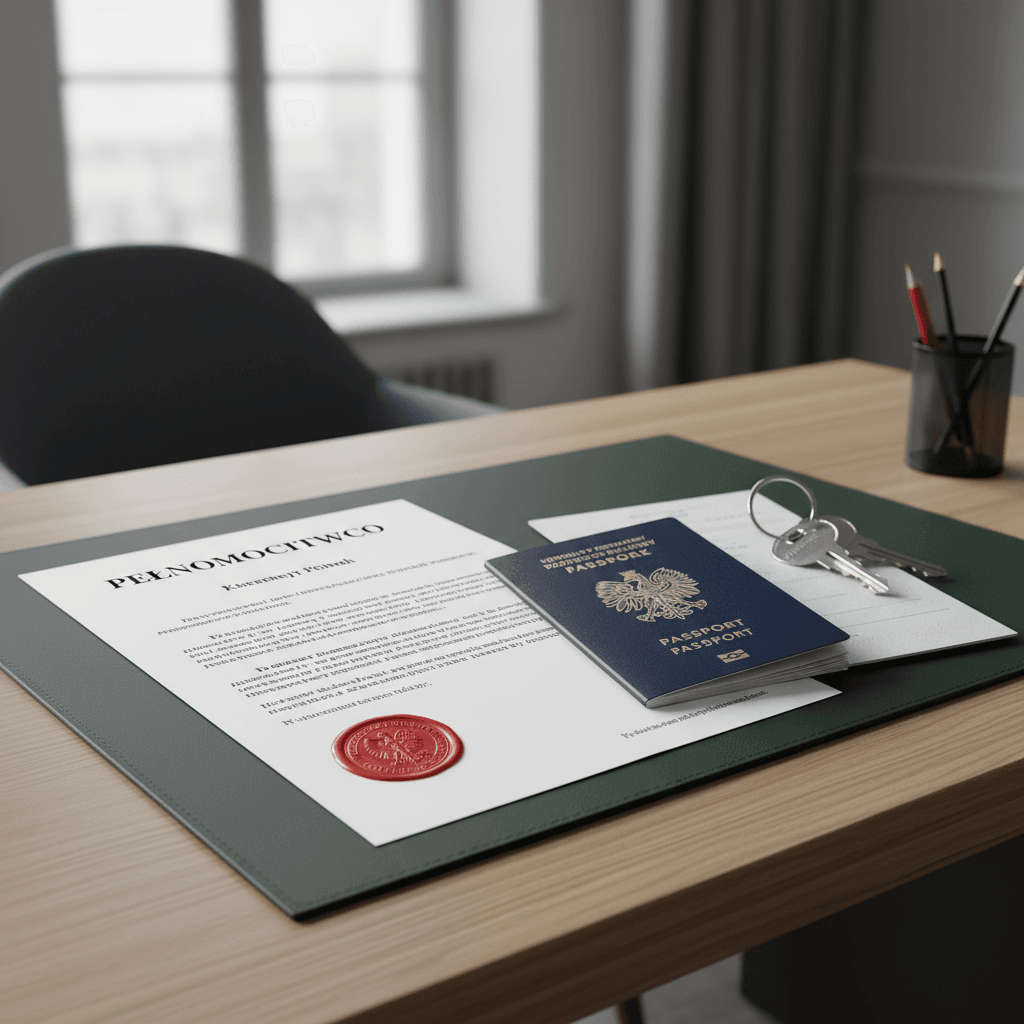
CGO Legal drafts all PoA documents bilingually and scopes them tightly to the specific transaction — authorising only the purchase of a named property at an agreed maximum price, with no broader financial powers. This limits your exposure.
Our full remote conveyancing service is described on the conveyancing in Poland service page.
Checking the Land and Mortgage Register (Księga Wieczysta)
Nearly every property in Poland has an entry in the Land and Mortgage Register (Księga Wieczysta, KW) — a public online database maintained by the regional courts, available at ekw.ms.gov.pl.
The register has four divisions:
- Division I: property description — size, location, attached rights.
- Division II: ownership — who owns it and on what legal basis.
- Division III: rights, claims and encumbrances — easements, enforcement proceedings, occupancy rights, pre-emption rights. This division most often contains deal-breaking information.
- Division IV: mortgages — every registered mortgage, the creditor, and the secured amount.
To check the register you need the 15-character KW number from the seller. A seller who refuses to provide it is a red flag.
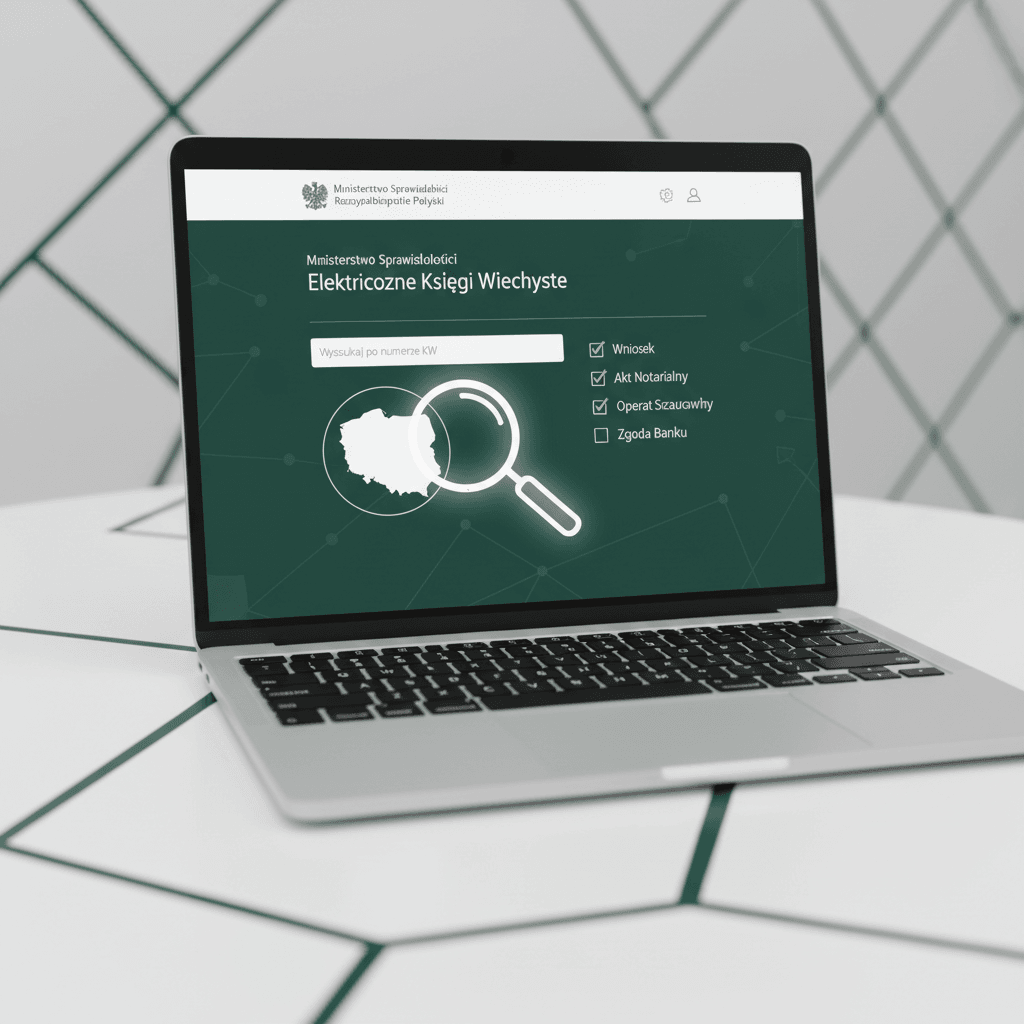
One critical detail: the register may show a notation (wzmianka) indicating an application is being processed but not yet registered. A wzmianka in Division III or IV means something new — a mortgage, enforcement order or claim — is being added right now. Always check the status of any active wzmianka before signing.
Common Mistakes Foreign Apartment Buyers Make
Based on the cases we handle, these are the most frequent problems:
1. Assuming the notary is their lawyer. The notary ensures the transaction is valid — not that it is in your interest. They will not warn you that a clause is unfair or that the price is above market.
2. Signing the preliminary agreement without legal review. It locks in the deposit structure, penalties, and timeline — terms that directly affect your exposure if something goes wrong.
3. Not checking the Land Register for active wzmianki. A register that looks clean today may have a mortgage application in progress.
4. Overlooking outstanding management fees. Condominium associations can pursue the current owner for fees owed by previous owners. Request a statement before closing.
5. Buying in a border zone without checking permit status. A coastal apartment can trigger a permit requirement that a flat in Warsaw would not.
6. Trying to use a company to avoid the permit. Polish authorities look through the corporate structure. A company controlled by a non-EU person still triggers the permit requirement.
7. Underestimating the timeline when a permit is needed. For border-zone or house purchases, add 2–4 months and start the application early.
Is Buying an Apartment in Poland a Good Idea? (The Legal View)
Investment analysis sits outside legal advice, and we leave market forecasts to financial advisors. But from a legal and transactional standpoint, several facts are worth knowing.
The Polish property market is well-regulated. Transactions through a notary are highly secure, and the Land Register system provides strong title protection — once you are registered as owner, your title is robust. The legal risks in a Polish apartment purchase are manageable, provided due diligence is done properly.
Recurring costs are low by European standards: annual property tax on a typical 60 m² apartment runs roughly 100–600 PLN per year. There is no foreign-ownership surcharge, and no limit on how many units a foreigner can own.
For buyers intending to let the apartment, rental income is taxable in Poland, and non-residents should take advice on how this interacts with any double-taxation treaty with their home country. We can advise on the legal and tax framework, though not on whether a specific purchase is a sound investment.
FAQ — Buying an Apartment in Poland as a Foreigner
How CGO Legal Helps Foreign Apartment Buyers
CGO Legal handles apartment purchases for international clients across Poland. Our team works in English, German, French, Italian and Russian, and is structured to support buyers who are not physically present in Poland.
Our standard involvement in an apartment purchase covers:
- Review and negotiation of the preliminary agreement (umowa przedwstępna)
- Full due diligence audit with a written report in English
- Preparation of the Power of Attorney for remote purchase
- Coordination with the notary and review of the draft deed
- Attendance at closing on your behalf under the PoA
- Post-transaction Land Register monitoring
For clients buying a house or land who need a Ministry permit, we manage the full application in parallel — see our guide to buying a house in Poland and permit service page.
To discuss your purchase, contact our real estate team. We respond within one business day and offer an initial consultation to assess your situation before any fees are agreed.
This guide is provided for general information only and does not constitute legal advice. Polish law on real estate acquisition by foreigners depends on individual circumstances, including nationality, property type, and location, and may change. This page reflects the law as understood at the date of last update. Before entering into any property transaction in Poland, seek independent legal advice specific to your situation.
